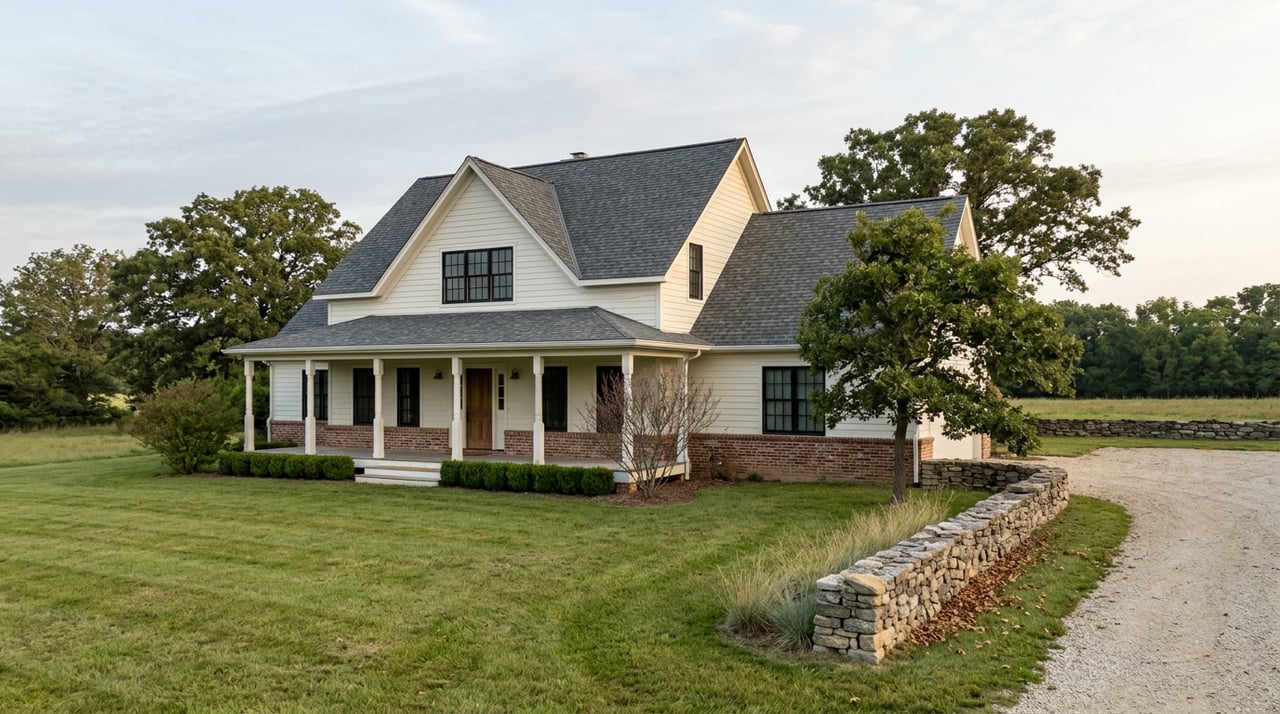
Newton County's Median Price Describes a Market That Doesn't Exist
September 24, 2026
September 24, 2026
What does $230,000 buy in Newton County, Missouri? The honest answer is that it depends entirely on which town you mean, because the $230,000 figure is a specific town's number, not the county's. It is an average home value tracked for Neosho, not a guide to what that budget buys across the county.
That matters if you are comparing Neosho, Seneca, Diamond, and Granby based on a single headline figure. The number will tell you almost nothing about why one town's homes move in nineteen days and another's sit while a nonprofit rebuilds Main Street around them.
As of late July 2026, the average home value tracked for Neosho sat at $230,912, up 4.7 percent over the prior year, with homes moving to pending in around 19 days. That is a specific, current number for a specific town. It is not the county's number, and it should not be treated as one.
Zoom out to the county level and the picture gets messier on purpose. A separate countywide snapshot from mid-2026 put the median list price across Newton County at $329,900, with about 4.5 months of supply and roughly 280 new listings hitting the market in a typical 30-day stretch. That figure measures something different: what sellers are currently asking, weighted toward whatever mix of homes happens to be listed right now, not what buyers are actually paying town by town. One countywide aggregator also puts Seneca as the least expensive city it tracks in the county, with average home prices in the high $190,000s, while pricier communities on the county's edges list well into the $400,000s.
None of these numbers are wrong. They are measuring different slices of the same county, and that is exactly the problem with quoting any single one of them as "the market."
| Town | Local context | What a buyer should consider |
|---|---|---|
| Seneca | Local employment context near the state line | A specific home's location and features |
| Neosho | County seat status and a downtown that keeps buyers coming back | A house that will resell quickly if your plans change |
| Diamond | 240 acres of federal land that will never be developed or sold | Quiet a commercial strip couldn't offer at any price |
| Granby | An infrastructure bet that hasn't fully shown up in prices yet | A number that may look different in a few years |
Seneca sits close enough to the Oklahoma line that its labor market barely respects the state boundary. Simmons Foods, a family-owned poultry, pet food, and animal nutrition company that has operated since 1949, runs a hiring center a few miles south in Southwest City, Missouri, pulling in workers for scale operator, maintenance, and production roles across the corridor. For buyers, the local job base is one part of the context to weigh alongside the specific home.
Seneca's lower average price relative to the rest of the county is not, on its own, evidence of distress or a sign the town is falling behind. The average alone does not explain the difference.
Neosho's downtown square and weekend market rhythm get plenty of attention on their own terms, and that texture matters to the people who live there day to day. But from a pricing standpoint, what actually distinguishes Neosho inside the county is liquidity. Nineteen days to pending, as of the most recent snapshot, is fast for a rural Missouri market. That speed is what county-seat status buys: a courthouse, a hospital system, a school district hub, and a buyer pool that includes people relocating for work in Joplin who want a shorter commute without Joplin's price tag.
If you are comparing Neosho to Seneca on price per square foot alone, you are comparing the wrong thing. You are really comparing how fast each town's inventory turns over, and that number tells you more about your own resale timeline than the sticker price does.
Diamond is two miles from the George Washington Carver National Monument, a 240-acre National Park Service site that preserves Carver's boyhood home and includes a three-quarter-mile nature trail. It was established in 1943, the first national monument dedicated to someone other than a president and the first dedicated to an African American. Admission is free, and it draws a steady trickle of visitors rather than a tourist economy.
That distinction matters for how it affects land around it. A commercial attraction that charges admission and needs parking, food service, and retail tends to push up land values on its edges. A federal monument with no gift shop and no admission fee does the opposite. It removes 240 acres from any future development pipeline and keeps the immediate area quiet, without generating the retail tax base or visitor spending that would pull commercial land prices up the way a similar acreage might near a paid attraction. Diamond stays a small, low-turnover market, not because demand is weak, but because there is very little land changing hands to begin with.
Granby was once the oldest lead mining town in southwest Missouri, a boomtown that swelled past 8,000 residents during the 1850s Granby Stampede before the ore ran out in the early 1950s and the town settled into a smaller bedroom and retiree population near 2,000. What makes Granby worth watching now isn't its history. It's what the town is doing with it.
In 2024, KOAM News Now reported that Granby had committed roughly $11 million to completely rebuild its water and sewer systems and had opened a new business incubator aimed at local entrepreneurs, since the town has never had much commercial building stock to work with.
"We don't have a lot of business buildings," said Barry Flint, who works with the local nonprofit Grow Granby, in the KOAM News Now report. "People have always, as a rule, in the past, tried to start a business out of their house or where they could find space. So this is what we're calling an incubator facility where they can try their ideas out and see if they work and go from there."
That is not the kind of investment that moves a median price overnight. Infrastructure spending shows up in a town's numbers years after the checks are written, usually once the new capacity attracts the businesses and residents it was built for. If you're looking at Granby's current price tag and comparing it to Neosho's, you're comparing today's number in one town to a number that Granby is actively trying to change in another.
The practical takeaway isn't that one of these four towns is objectively better. It's that the mechanism setting each town's price should shape what you ask before you get serious about a specific address.
Does the Carver Monument affect property taxes near Diamond? The monument itself is federal land and doesn't generate local property tax revenue, but it also doesn't pull commercial development or higher land values toward it the way a paid attraction would. Its effect on surrounding land is quiet rather than inflationary.
Is Seneca's lower average price a warning sign? Not on its own. The average price alone doesn't establish whether a market is distressed; compare specific homes and local conditions rather than infer a cause from the figure.
Why do these sources disagree on what Newton County homes cost? Because they're measuring different things. An average home value across existing homes, a median asking price across current listings, and a per-city breakdown from a data aggregator will never match exactly, since each one weights the mix of homes differently. That disagreement is itself the evidence that no single county number tells the whole story.
If you're weighing Neosho against Seneca, or wondering whether Granby's reinvestment is worth getting ahead of, that's a conversation worth having with someone who works these towns individually rather than reading them off a single county chart. Legacy Real Estate has spent 25-plus years watching these exact mechanisms play out property by property across Newton County. Get Your Free Home Valuation and we'll walk through what your specific town, and your specific address, actually has going for it.
This article is general information, not legal, tax or financial advice. Consult a qualified professional about your situation.
Stay up to date on the latest real estate trends.
Backed by local knowledge, strong relationships, and a passion for helping people, our team is committed to delivering a smooth and personalized real estate experience from start to finish.
LEGACY REAL ESTATE
18036 NEWTON RD DIAMOND, MO 64840