The McDonald County Driveway That Closes For One Buyer And Stalls For The Next
August 20, 2026
August 20, 2026
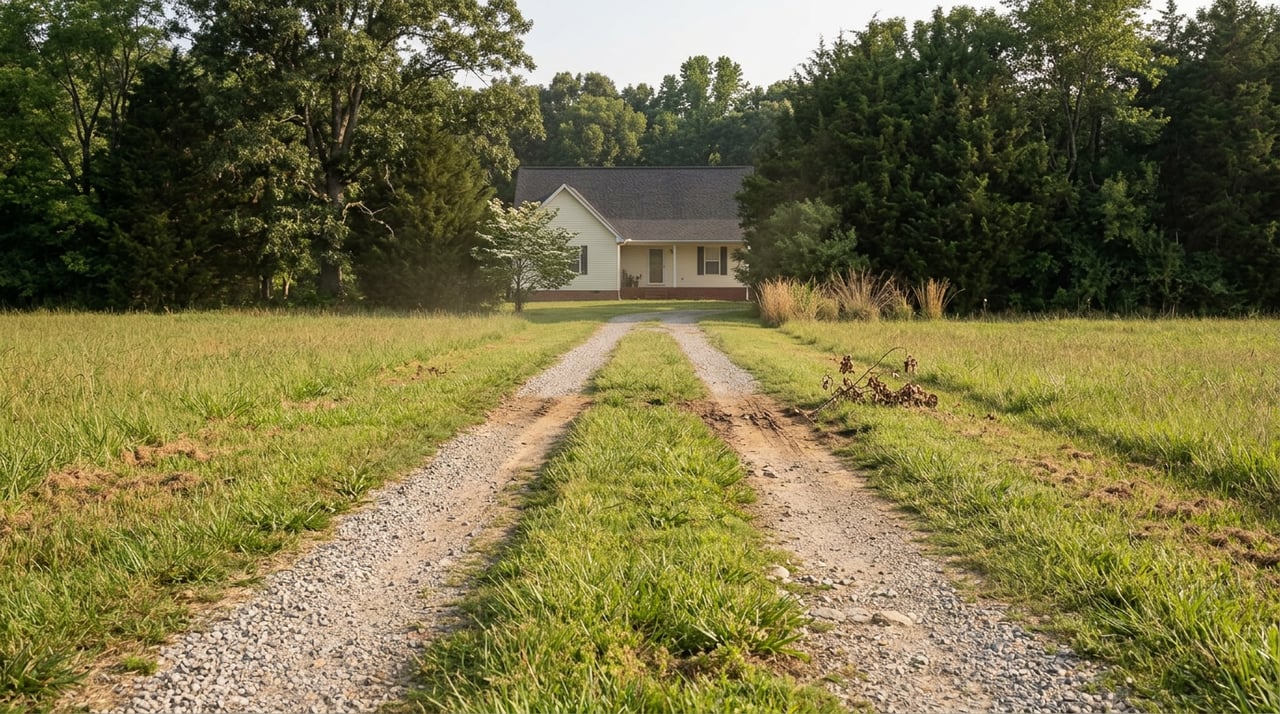
Picture the same twenty acres outside Pineville, reached by the same quarter mile of gravel that's shared with the neighbor's place. Two offers come in a month apart. The first buyer pays cash and closes in three weeks without anyone asking a single question about the lane. The second buyer is financing with a VA loan, and four days before closing, the lender's underwriter sends back a request nobody saw coming: a recorded Private Road Maintenance Agreement, signed by every property owner who uses that road.
The road hasn't changed. The seller hasn't changed. What changed is the loan.
Rural McDonald County runs on gravel. County-maintained roads thin out fast once you're off the state routes, and a lot of acreage, especially the kind subdivided off a family farm a generation or two back, sits at the end of a lane that was never surveyed, never recorded, and never formally shared by agreement. It works fine for the people living there. Everyone knows whose turn it is to grade it after a hard rain, and nobody's called a lawyer about it in thirty years.
That informality is exactly what an underwriter is trained to flag. A title company can tell a buyer that a property has legal access. It can't always tell a lender that the access is documented the way that specific loan program requires, and the requirement is not the same across loan types. That gap is where closings that looked clean on the contract start slipping their dates.
Missouri law doesn't require a shared driveway to be formalized before it becomes legally binding. A Missouri Court of Appeals case, Dohogne v. Counts, addressed a driveway two neighboring properties in Jackson, Missouri had shared for years under nothing more than an unwritten understanding. The court found that the long-standing arrangement was enough to create an implied easement, meaning the right to use that shared drive didn't depend on a signed document. Missouri also recognizes a prescriptive easement, which can form after ten years of open, continuous, uninterrupted use, even without the landowner's permission.
Both routes mean a road can be entirely real and entirely enforceable in a courtroom while having no recorded paper trail a title search would necessarily surface as a clean, described easement. For sellers, that's not a defect. It's just how rural Missouri roads have always worked. For a lender's file, it's a gap.
Missouri did try to build a backstop for the maintenance side of this. A 2012 law, now codified as RSMo 228.369, lets a circuit court step in and order a plan of maintenance, with costs split among the homeowners who use a private road, if those owners can't agree on one themselves in writing. It's a real remedy, but it's a court process. It exists precisely because so many of these roads were never put in writing in the first place, and it is not something you want to be sorting out during a thirty-day closing window.
This is the part that catches sellers off guard: the documentation a private road needs isn't a Missouri rule or a McDonald County rule. It's a lender rule, and it changes by loan type.
| Loan Type | What It Requires On A Private Road |
|---|---|
| VA | A recorded Private Road Maintenance Agreement |
| FHA | A recorded easement, but not necessarily a maintenance agreement |
| Conventional (Freddie Mac) | No Private Road Maintenance Agreement required |
| USDA | Determined case by case |
A cash buyer or a conventional buyer can move through that same gravel lane without a single question. A VA buyer hits a documentation requirement the seller may never have needed before. If the maintenance agreement doesn't exist yet, it has to get drafted and signed by every property owner on the road, and that's a negotiation you don't want to be starting for the first time after you're already under contract.
The fix here isn't complicated, but it has to happen before a buyer's loan type forces the question. A seller with acreage reached by a shared or private lane should be able to answer these before signing a listing agreement:
None of this requires a lawsuit or an appraisal fight. Most of the time it requires a conversation with the neighbors and a visit to the recorder of deeds to see what, if anything, is already on file.
A private road that's never caused you a problem can still be the reason your buyer's loan stalls three days before closing.
McDonald County's assessor classifies agricultural land at 12 percent of market value for tax purposes, well below the 19 percent rate applied to residential property. That lower rate is part of why family farm ground so often stays in ag classification and gets divided among heirs rather than platted and sold outright. A sibling keeps the home place, another sibling gets the back forty, and the driveway that served the original farmhouse ends up serving two or three parcels under separate ownership, all without anyone drawing up a formal road agreement, because there was never a sale that forced the question.
That's the exact profile of property where this friction shows up hardest. The road has worked for the family for decades. It's never been tested against a lender's requirements until the day one of those parcels goes on the market to a buyer who isn't paying cash.
Does this mean my title insurance is somehow bad? Not necessarily. Title insurance covers ownership defects. A lender's road documentation requirement is a separate, loan-specific underwriting condition, and it can exist even on a property with clean title.
What if the neighbors and I have just always shared the road without talking about it? That's the most common situation in rural McDonald County, and it's fixable, but it needs to happen before you're under contract, not during the loan's underwriting review.
Is my gravel road actually a county road? Not automatically. The McDonald County Commission handles maintenance and construction on public roads and bridges, but a private lane serving one or two properties generally isn't part of that system unless it's been formally accepted into it.
Can a title company or attorney draft this for me? Yes, and that's the right call. A recorded easement description and a written maintenance agreement are documents worth having a professional prepare correctly the first time, since they'll be read by underwriters, not just neighbors.
None of this is legal advice, and every situation on the ground is a little different. A title company or a real estate attorney can tell you exactly what's recorded on your specific parcel and what it would take to formalize what's already informally true.
If you're getting ready to list acreage in McDonald County that's reached by a shared lane, or you're just not sure what's on file for the road you've driven every day for twenty years, Legacy Real Estate can help you find out before a lender does. Get Your Free Home Valuation and let's look at the whole picture, road included.
Stay up to date on the latest real estate trends.

Backed by local knowledge, strong relationships, and a passion for helping people, our team is committed to delivering a smooth and personalized real estate experience from start to finish.

LEGACY REAL ESTATE
18036 NEWTON RD DIAMOND, MO 64840